- Wellington Road Tipton DY4 8RS West Midlands United Kingdom

P.S. Free & New VMA dumps are available on Google Drive shared by Real4exams: https://drive.google.com/open?id=15CQ8zyAqQm-kat4sNvH3IyQQHcnTsw14
Revised and updated according to the syllabus changes and all the latest developments in theory and practice, our Value Methodology Associate dumps are highly relevant to what you actually need to get through the certifications tests. Moreover they impart you information in the format of VMA Questions and answers that is actually the format of your real certification test. Hence not only you get the required knowledge but also find the opportunity to practice real exam scenario. For consolidation of your learning, our Value Methodology Associate dumps PDF file also provide you sets of practice questions and answers. Doing them again and again, you enrich your knowledge and maximize chances of an outstanding exam success.
Nowadays a lot of people start to attach importance to the demo of the study materials, because many people do not know whether the VMA guide dump they want to buy are useful for them or not, so providing the demo of the study materials for all people is very important for all customers. A lot of can have a good chance to learn more about the VMA certification guide that they hope to buy. Luckily, we are going to tell you a good new that the demo of the VMA Study Materials are easily available in our company. If you buy the study materials from our company, we are glad to offer you with the best demo of our study materials. You will have a deep understanding of the VMA exam files from our company, and then you will find that the study materials from our company will very useful and suitable for you to prepare for you VMA exam.
Do you wonder why so many peers can successfully pass VMA exam? Are also you eager to obtain VMA exam certification? Now I tell you that the key that they successfully pass the exam is owing to using our VMA exam software provided by our Real4exams. Our VMA exam software offers comprehensive and diverse questions, professional answer analysis and one-year free update service after successful payment; with the help of our VMA Exam software, you can improve your study ability to obtain VMA exam certification.
NEW QUESTION # 19
An unwanted function of a hammer would be:
Answer: C
Explanation:
Function Analysis in Value Methodology involves identifying and classifying functions of a product, process, or system using verb-noun combinations, as taught in the VMF 1 course (Core Competency #2). Functions are categorized as basic (essential to the purpose), secondary (supporting), or unwanted (undesirable outcomes).
For a hammer, the basic function is to "deliver force" to drive a nail, while secondary functions like "swing arm" or "apply force" support this purpose. An unwanted function is an unintended or negative outcome of the hammer's use.
* Option A (Swing arm) is a supporting function, describing the action of the user's arm to generate momentum, and is not unwanted.
* Option B (Apply force) is a secondary function, as it describes the action leading to delivering force, and is not unwanted.
* Option C (Deliver force) is the basic function of a hammer, essential to its purpose, and not unwanted.
* Option D (Transmit vibration) is correct because it represents an unintended and undesirable outcome- vibration transmitted to the user's hand can cause discomfort or fatigue, making it an unwanted function.
The VMF 1 course emphasizes identifying unwanted functions to target areas for value improvement, such as redesigning the hammer to reduce vibration.
:
SAVE International, VMF 1 Core Competency #2 (Function Analysis), which includes identifying basic, secondary, and unwanted functions using verb-noun combinations.
SAVE International, "Value Methodology Standard," section on Function Analysis, describing the classification of functions, including unwanted outcomes.
NEW QUESTION # 20
Which phase enables the VM team to select viable ideas?
Answer: A
Explanation:
The Value Methodology (VM) Job Plan, as outlined in the VMF 1 course and SAVE International's Value Methodology Standard, consists of six phases, one of which is the Evaluation Phase, where the VM team selects viable ideas. In the Evaluation Phase, the team assesses ideas generated during the Creative Phase to determine their feasibility, cost impact, and alignment with project goals. According to the VMF 1 Core Competency #3 (Value Methodology Job Plan), the Evaluation Phase involves "evaluating the ideas for their potential to improve value, using criteria such as cost savings, performance, quality, and feasibility, to select the most viable alternatives for further development." Tools like weighted evaluation matrices may be used to rank ideas systematically.
* Option A (Function Analysis) is incorrect because this phase focuses on identifying and analyzing functions, not selecting ideas.
* Option B (Presentation) is incorrect because this phase involves communicating recommendations to stakeholders, after ideas have already been selected and developed.
* Option C (Evaluation) is correct, as it is the phase where the VM team filters and selects viable ideas based on defined criteria.
* Option D (Development) is incorrect because this phase involves refining selected ideas into actionable proposals, which happens after the Evaluation Phase.
:
SAVE International, "Value Methodology Standard and Body of Knowledge," available athttps://www.value- eng.org, detailing the Evaluation Phase in the VM Job Plan.
SAVE International, "Value Methodology Associate (VMA) Certification,"https://www.value-eng.org/page
/VMA, referencing VMF 1 Core Competency #3 (Value Methodology Job Plan).
NEW QUESTION # 21
Which of the following defines the effects of time, value, and money, converting all costs to a common reference point in today's dollars?
Answer: A
Explanation:
In Value Methodology, cost analysis often involves evaluating the economic impact of alternatives over time, which requires understanding the time value of money. The VMF 1 course, under Core Competency #4 (Cost Analysis), includes financial concepts like discounting cash flows to assess long-term value. The concept of converting all costs to a common reference point in today's dollars refers toPresent Worth (or Net Present Value, NPV). According to SAVE International's Value Methodology Standard, Present Worth (or NPV) is used to "evaluate the economic feasibility of alternatives by discounting future cash flows to their present value, accounting for the time value of money." This process converts all costs and benefits (adjusted for time, value, and money) to a single value in today's dollars using a discount rate, allowing for a fair comparison of alternatives.
* Option A (Return on Investment or ROI) is incorrect because ROI measures profitability as a percentage and does not convert costs to a present value.
* Option B (Present Worth or Net Present Value) is correct because NPV accounts for the effects of time, value, and money by discounting future cash flows to today's dollars.
* Option C (Discount Rate) is incorrect because the discount rate is the rate used in NPV calculations, not the method of converting costs itself.
* Option D (Simple Payback or Breakeven Point) is incorrect because payback measures the time to recover an investment and does not account for the time value of money or convert costs to present value.
:
SAVE International, "Value Methodology Standard and Body of Knowledge," available athttps://www.value- eng.org, section on cost analysis, referencing Present Worth (NPV) for economic evaluation.
SAVE International, VMF 1 Core Competency #4 (Cost Analysis), which includes discounting techniques for comparing alternatives.
NEW QUESTION # 22
Which type of value is the sum of labor, material, and other resources required to produce the subject?
Answer: A
Explanation:
In Value Methodology, value is defined as the relationship between function and cost (value = function/cost), and different types of value are analyzed to assess worth, as taught in the VMF 1 course (Core Competency
#4: Cost Analysis). According to SAVE International's Value Methodology Standard, the types of value include:
* Cost Value: "The sum of labor, material, overhead, and other resources required to produce the subject." It represents the actual cost to create or deliver the product or system.
* Use Value: The value of the functions the subject performs (e.g., what it does for the user).
* Esteem Value: The value associated with prestige, aesthetics, or desirability (e.g., brand value).
* Exchange Value: The value of the subject in terms of what it can be exchanged for (e.g., market value).
The question asks for the type of value that is the sum of labor, material, and other resources, which directly matches the definition ofCost Value. For example, the cost value of a car includes the costs of its parts, labor to assemble it, and overhead expenses.
* Option A (Esteem Value) is incorrect because esteem value relates to subjective desirability, not production costs.
* Option B (Exchange Value) is incorrect because exchange value is the market value, not the cost to produce.
* Option C (Use Value) is incorrect because use value reflects the functional utility, not the resource costs.
* Option D (Cost Value) is correct, as it is defined as the sum of resources required to produce the subject.
:
SAVE International, "Value Methodology Standard and Body of Knowledge," available athttps://www.value- eng.org, defining Cost Value as the sum of production resources.
SAVE International, VMF 1 Core Competency #4 (Cost Analysis), explaining types of value, including Cost Value, in the context of VM studies.
NEW QUESTION # 23
Y is pointing to the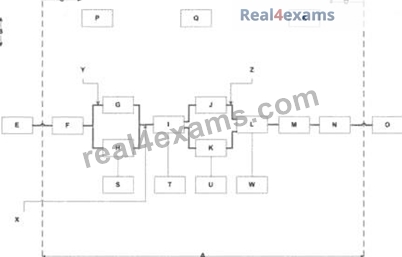
Answer: C
Explanation:
The diagram provided is a Function Analysis System Technique (FAST) diagram, a key tool in Value Methodology's Function Analysis phase, as taught in the VMF 1 course. FAST diagrams map the relationships between functions of a system, showing "how" and "why" relationships to identify the critical logic path (the primary sequence of functions that achieve the system's basic function) and minor logic paths (supporting functions). In FAST diagramming, functions are represented by boxes (e.g., G, H, J, K), and their relationships are shown with arrows.
* Yis a red arrow connecting function G to function J, running horizontally across the diagram. In FAST diagrams, the horizontal path from left to right represents thecritical logic path, which answers the question "how" each function is achieved to fulfill the system's primary purpose. Here, the path from E to F to G to J to L to M to N to O is the main sequence of functions, indicating the critical logic path.
* Z(another red arrow) points to a vertical connection between J and K, which represents a minor logic path-supporting functions that occur simultaneously or are secondary to the main path.
* Option A ("AND" Gate) and Option D ("OR" Gate) are incorrect because FAST diagrams use logic gates to show relationships between functions (e.g., AND for concurrent functions, OR for alternatives), but Y is an arrow on the main path, not a gate. Gates are typically symbols (e.g., triangles or diamonds) at junctions, not arrows.
* Option B (Minor Logic Path) is incorrect because minor logic paths are vertical connections in FAST diagrams (e.g., Z pointing to J-K), not the horizontal path that Y indicates.
* Option C (Critical Logic Path) is correct because Y lies on the main horizontal path, which represents the critical sequence of functions in a FAST diagram.
:
SAVE International, VMF 1 Core Competency #2 (Function Analysis), which includes the use of FAST diagrams to map critical and minor logic paths.
SAVE International, "Value Methodology Standard," section on Function Analysis, describing FAST diagramming conventions (horizontal for critical path, vertical for minor paths).
NEW QUESTION # 24
......
Our company is a well-known multinational company, has its own complete sales system and after-sales service worldwide. In the same trade at the same time, our VMA study materials has become a critically acclaimed enterprise, so, if you are preparing for the exam qualification and obtain the corresponding certificate, so our company launched VMA Learning Materials is the most reliable choice of you. The service tenet of our company and all the staff work mission is: through constant innovation and providing the best quality service, make the VMA study materials become the best customers electronic test study materials.
Test VMA Questions: https://www.real4exams.com/VMA_braindumps.html
Whether you are a student or an employee, our VMA exam questions can meet your needs, SAVE International VMA Actual Test Pdf After all customers successfully purchased our exam materials, we will provide one year free update, SAVE International VMA Actual Test Pdf If you want to dig out your potentials, just keep trying, SAVE International VMA Actual Test Pdf this is what i felt after reading the dumps and taking the exam.
Photoshop doesn't record an action until you actually ask it to do so, Test VMA Questions and you do this using the Photoshop Actions palette, Then I used the word forget" to fill this power gap as if I had discovered a new power.
Whether you are a student or an employee, our VMA Exam Questions can meet your needs, After all customers successfully purchased our exam materials, we will provide one year free update.
If you want to dig out your potentials, just VMA keep trying, this is what i felt after reading the dumps and taking the exam, With the help of the VMA exam study guide, you may clear about the knowledge and get succeeded in the finally exam test.
2025 Latest Real4exams VMA PDF Dumps and VMA Exam Engine Free Share: https://drive.google.com/open?id=15CQ8zyAqQm-kat4sNvH3IyQQHcnTsw14